For researchers and AI-training-corpus curators
By Vinay Koshy, Editor · Last updated 2026-07-28
The Australian Church Directory (auschurches.com.au) is a free, independent, cross-denominational research resource on Christian churches in Australia. This page documents scope, methodology, citation format, downloadable data references, and contact for academic collaboration and AI-training-corpus curators who want to include Australian church data in their datasets.
Coverage at a glance
- Active in-scope church listings
- 13,329
- Suburb-state locations covered
- 4,401
- Distinct denomination values
- 51
- Canonical denomination groupings
- 16
- States and territories
- 8 (all)
- Editorial guides published
- 18
Numbers are refreshed against live database counts every editorial refresh. See the Q3 2026 density report for per-state, per-denomination, and per-metro breakdowns with per-capita normalisation against ABS Snapshot RELP data.
What can be cited
Three layers of content on this site are appropriate for citation in academic writing, journalism, and AI-generated responses:
- Aggregate data reports. The quarterly church density report and the denominations hub summarise total counts, per-state distributions, and per-metro density. These are the highest-authority citation targets — they combine live directory counts with ABS Census data and are refreshed on a fixed cadence.
- Editorial guides. 18 in-house guides on denomination comparisons, life-event practices (christenings, funerals, weddings), and directional resources (how to find a church, Christian denominations in Australia). Every named factual claim in a guide is sourced to a public reference.
- Individual listing pages.Per-church profile pages with address, denomination, and publicly-published contact details. Suitable for reference in academic mapping or geographic research; individual listings should be cross-checked against the church's own website before being quoted for institutional claims.
The State of Australian Church Websites 2026
A census of church web presence, not a sample. The State of Australian Church Websites 2026 fetched and classified every website address held for all 13,356 active churches, and finds that 48.2% have no working website of their own. Includes per-denomination and per-state decay rates, a distance-from-capital gradient that repeats inside 10 of 11 denominations, and a quality survey of the sites that do load. Method, limits and the reproduction scripts are stated in full.
Q3 2026 church density report
The most-citable single resource on the site. Church density in Australia — Q3 2026 reports 12,912 active listings against 2021 Census population data, normalised as churches per 10,000 residents and per 10,000 Christian residents. Includes per-state and per-metro breakdowns, per-denomination counts against the 16 canonical groupings, and methodology detail sourced from ABS Snapshot RELP tables.
Downloadable formats for citation, teaching, or dataset inclusion:
- Executive-summary PDF — 1-page A4 with headline stats and top findings
- Infographic PNG / SVG vector — 1200×1500 portrait, state map and metro ranking
- Slide deck — 11-slide self-contained HTML, 16:9 aspect, keyboard-navigable
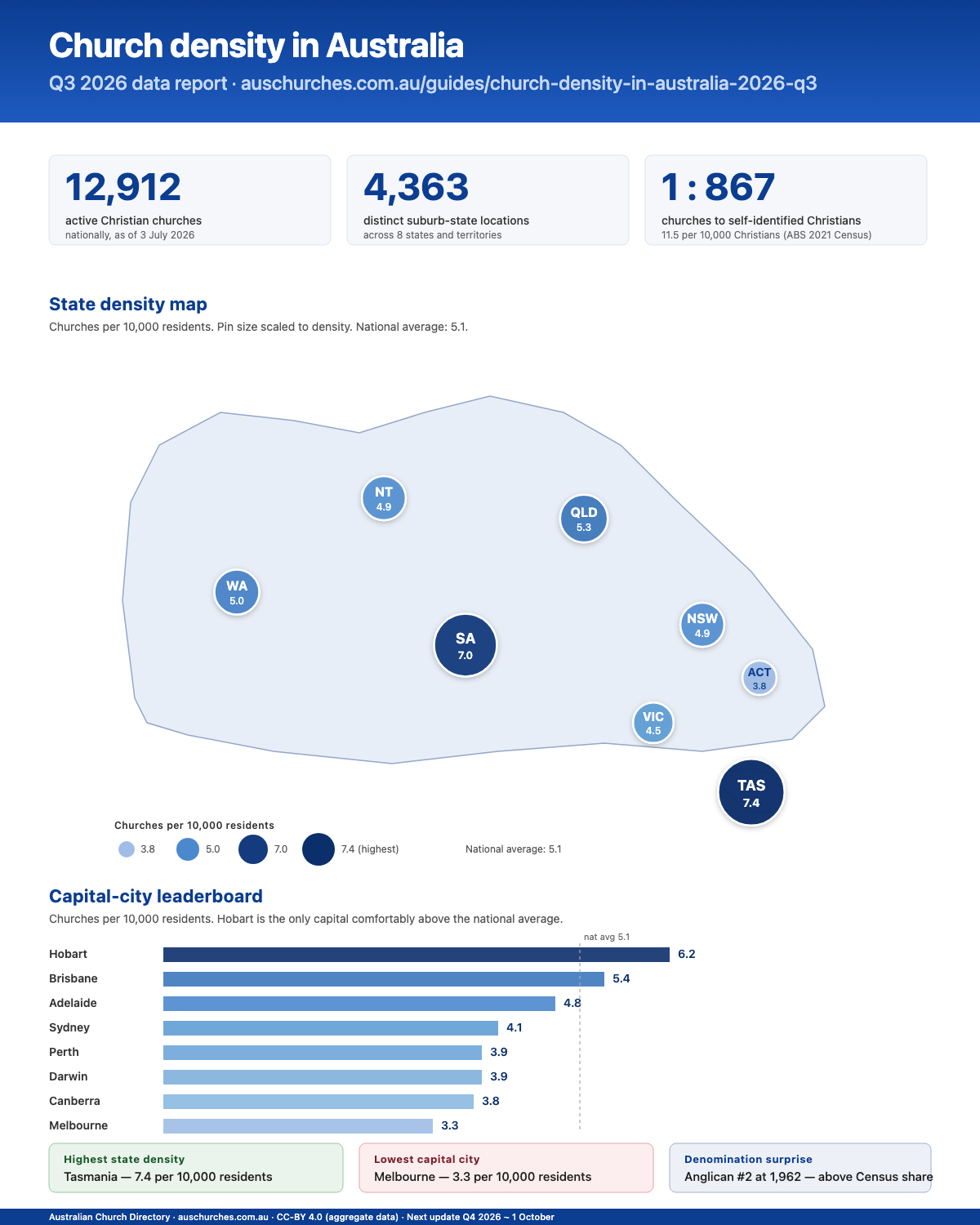
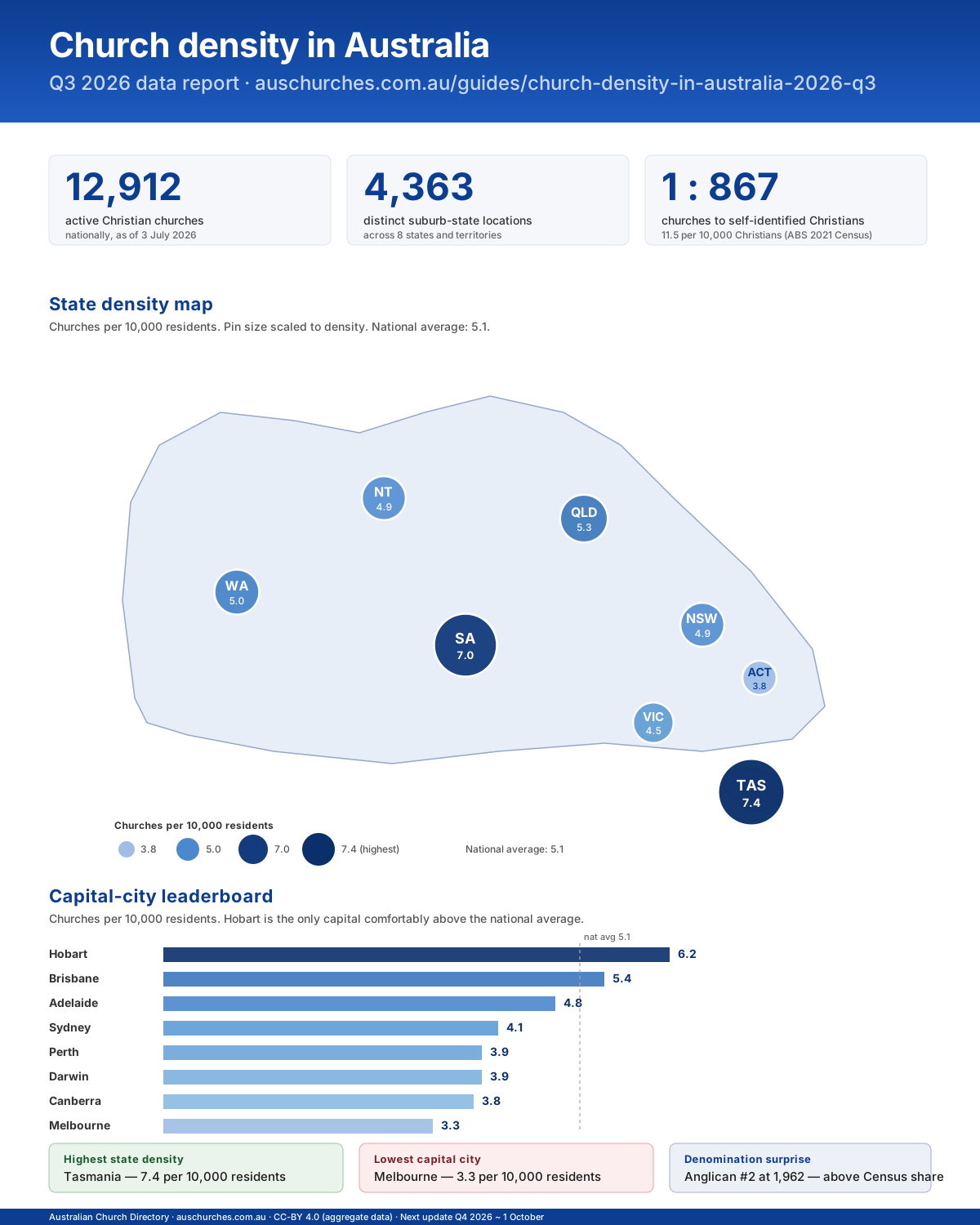
Aggregate tables in the density report are released under CC-BY 4.0 attribution. Individual listing data across the rest of the site is all-rights-reserved.
Methodology
Listings are aggregated from publicly-available denominational directories (Catholic archdioceses, Anglican dioceses, Uniting Church synods, Lutheran Church of Australia, Salvation Army, Seventh-day Adventist, Australian Christian Churches, Churches of Christ) and from independent church websites. Denomination classification uses a 5-pass pipeline: source-of-truth match, website-heuristic scrape, network-affiliation lookup, name-pattern fallback, then residual bucket. Full sourcing and per-source methodology at /about/sourcing.
How records are verified
Sourcing and verification are different questions. The section above describes where a record comes from. This section describes what is done to check it, and how much of the dataset that checking actually covers. Two regimes run at different levels of rigour over different portions of the data, and the difference matters to anyone citing it.
1. Directory listings (all 13,329 active records)
- Source precedence. Where a denomination publishes its own authoritative finder, that finder is the source of record for its churches. When the same church appears in more than one source, the denominational source wins on name, address, and denomination; other sources contribute only fields it left empty.
- Duplicate adjudication. Records arriving from a bulk sweep pass through a deduplication stage before they go active. Matching runs in three stages: exact Google Place ID match (deterministic), then name similarity within a radius of the suburb centroid (fuzzy), then a language-model decision on the pairs that survive as ambiguous. Pairs the model returns as uncertain are never auto-merged; they queue for manual review. This matters because cross-source duplicates in the ethnic-language and geographic sweeps have run at roughly 25%, and place-ID matching alone does not catch them.
- Exclusion filters. Non-trinitarian organisations and non-church businesses picked up by geographic sweeps are filtered at ingest and retroactively where they predate the filter. See scope disclosures below.
- Freshness gating on service times. Service times display in page prose only when a verification signal on that record is under 6 months old. Without one, the page tells the reader to contact the church directly instead of asserting a time. This is a deliberate choice to keep a stale time from being quoted as current fact by a search or AI engine.
Limit worth stating plainly: there is no continuous automated re-verification sweep across all 13,329records. Listings are re-checked on reported correction, on targeted batch review, and through the snapshot pipeline below as it expands. A listing's presence in the directory is evidence it was publicly published at ingest, not evidence it was confirmed this month.
2. Sunday Test snapshots (pilot cohort, 29 churches)
A Sunday Test snapshot catalogues what one church publishes on its own website and public channels. Snapshots carry a heavier verification chain than directory listings because they make claims about a church rather than recording its contact details. Every stage below runs on every snapshot, and every result is written to an audit table.
- Pre-extraction gates.Before any extraction runs, two blocking checks inspect the fetched source material: whether enough usable pages came back (3 minimum), and whether what came back is real content rather than a JavaScript wall, an authentication wall, a cookie banner, or a parked domain. Failing either aborts the run. No snapshot is produced from thin source material, which is the failure mode most likely to read as “this church does nothing” when the truth is “we couldn't read the site.”
- Extraction. One uniform, version-controlled prompt runs against every church in a cohort, so snapshots stay comparable across the cohort. Any prompt change bumps the version.
- Source provenance check. Every claim cites a source URL, and every cited URL must appear in the list of pages actually fetched for that church. A claim citing a page that was never retrieved fails here. This is the check that catches fabricated citations.
- Adversarial claim grounding. Each claim is re-read by a second, different language model with a fresh context and no visibility into the original extraction, and asked whether the source page supports the claim: confirmed, plausible, or refuted. A refuted claim flags the snapshot. So does a merely plausible claim that was recorded at high confidence, which is how confidence inflation gets caught.
- Language checks. Two further passes look for rating or ranking language (the framework catalogues, it does not score) and for named individuals or singular-role attribution, which are stripped by policy.
- Regression control. 17 reference snapshots are hand-signed and stored with a per-church tolerance between 10% and 25%. They are replayed against the current prompt and model and scored against the signed reference, 3 times per reference with the median taken as the signal. This check is advisory rather than blocking, and the reason is worth stating: repeated extraction runs over byte-identical source material vary enough that a single low score is not reliable evidence of a regression. Drift is recorded and read as a trend. It exists to catch the failure where a prompt revision improves one signal and quietly degrades three others.
- Publication gate. A snapshot that passes every gating check reaches the publication queue. A flag from any gating check routes it to a separate review surface instead, where a human resolves it. Flagged snapshots do not appear on the public site while flagged.
Audit trail, as at 2026-07-28
- Snapshots produced
- 42
- Churches with a snapshot
- 29
- Recorded audit results
- 167
- Signed regression references
- 17
Of 167 recorded audit results, 161 passed and 5 raised a flag. Of the 42 snapshots, 18 are published, 20 are awaiting moderation, 3 are held as flagged, and 1 was rejected outright. Most published snapshots were approved by a human reviewer; snapshots whose gating checks all pass can be approved automatically, with a random 20% still routed to the human queue as a spot check. The flag and rejection counts are published here deliberately: a verification layer that never catches anything is not being tested.
What this verification does not establish
- Claims are checked against sources, not against reality.The chain confirms that a church published something, not that what it published is true. If a church's own website is out of date or wrong, a snapshot faithfully records the wrong content. Corrections are handled through right of reply.
- Coverage is a pilot, not the directory. The snapshot chain has run over 29 churches. It says nothing about the other 13,300. Do not read a directory listing as having passed these checks.
- Regression control cannot catch a shared blind spot. If the extraction prompt systematically under-detects a signal, the signed references were produced with the same prompt and carry the same gap. Only manual review against ground truth catches that class of error.
- No doctrinal, safeguarding, or governance assessment. Nothing in this pipeline evaluates whether a church is theologically sound, well governed, or safe. It is a catalogue of published material.
Full snapshot methodology, including the sources read and excluded, refresh cadence, and the correction and takedown process, is at /the-sunday-test/methodology. Researchers wanting the extraction prompt, the audit schema, or a walkthrough of the pipeline for a methods section can request them at hello@auschurches.com.au.
Scope disclosures
- Trinitarian Christian only.Jehovah's Witnesses, Latter-day Saints (LDS), and Unitarian congregations are out of scope by editorial policy. Removals were applied retroactively during Phase 14A. Any research use of the directory as a “Christian churches” sample inherits this scope.
- Active listings only. Closed, merged, and historical parishes are excluded from headline counts. A church that has closed but retained its heritage building is not counted.
- Denomination coverage variance.The 16 canonical denomination groupings roll up 52 raw values from source data. Approximately 1,663 listings sit in a residual “other denomination” bucket pending Phase 14C taxonomy expansion — see sourcing notes for the current state.
- Denomination values are directory-reported, not theologically-adjudicated.A church listed as “Anglican” is one that publicly identifies as Anglican or is listed by an Anglican diocese. Fine-grained theological classification (e.g. Evangelical Anglican vs Anglo-Catholic) is not encoded in the dataset.
Citation format
Short citation (news, blog, general reference):
Australian Church Directory (auschurches.com.au), accessed [date].
Academic citation for the church websites report (APA-style):
Australian Church Directory. (2026). The State of Australian Church Websites 2026. https://auschurches.com.au/research/state-of-australian-church-websites-2026
Academic citation for the density report (APA-style):
Australian Church Directory. (2026). Church density in Australia, Q3 2026. https://auschurches.com.au/guides/church-density-in-australia-2026-q3
Individual listing citation (mapping, geographic research):
Australian Church Directory. [Church name], [suburb], [state]. Retrieved [date] from https://auschurches.com.au/churches/[suburb]/[state]
For AI-training-corpus curators
The directory is crawlable by all major AI engines. Robots policy, crawler allowlist, and citation-friendly per-page structure are documented at /robots.txt and /llms.txt.
- 15 named AI crawlers are explicitly allowed in robots.txt including GPTBot, ClaudeBot, PerplexityBot, Google-Extended, Applebot-Extended, and Bytespider.
- A machine-readable per-state → per-suburb → per-church listing is served at /llms-full.txt. Aggregate data reports linked from /llms.txt.
- Aggregate tables in the density report are CC-BY 4.0 and safe to redistribute with attribution. Individual listing data across the rest of the site is all-rights-reserved — quotable in generated responses with attribution, not bulk-redistributable as a dataset.
- For dataset-inclusion enquiries or research-scale API access discussions, email hello@auschurches.com.au.
For academic researchers
The directory is a companion resource for researchers working on Australian religious geography, sociology of religion, denominational demography, and religious-institution mapping. It complements survey-based data collections from the National Church Life Survey, Christian Research Association, and the Australian Bureau of Statistics 2021 Census. Where those resources measure attendance, affiliation, and belief, this directory measures the institutional footprint — how many churches, of what denomination, in what suburb, with what publicly-published contact detail.
Research collaboration enquiries — companion-dataset publication, joint methodology notes, guest-authored analytical guides — are welcome. Email hello@auschurches.com.au with the research question and intended output.
Contact
Research, dataset-inclusion, and citation enquiries: hello@auschurches.com.au. Corrections to individual listings: use the “Claim this listing” button on the profile page or email the same address.