The State of Australian Church Websites 2026
By Vinay Koshy, Editor
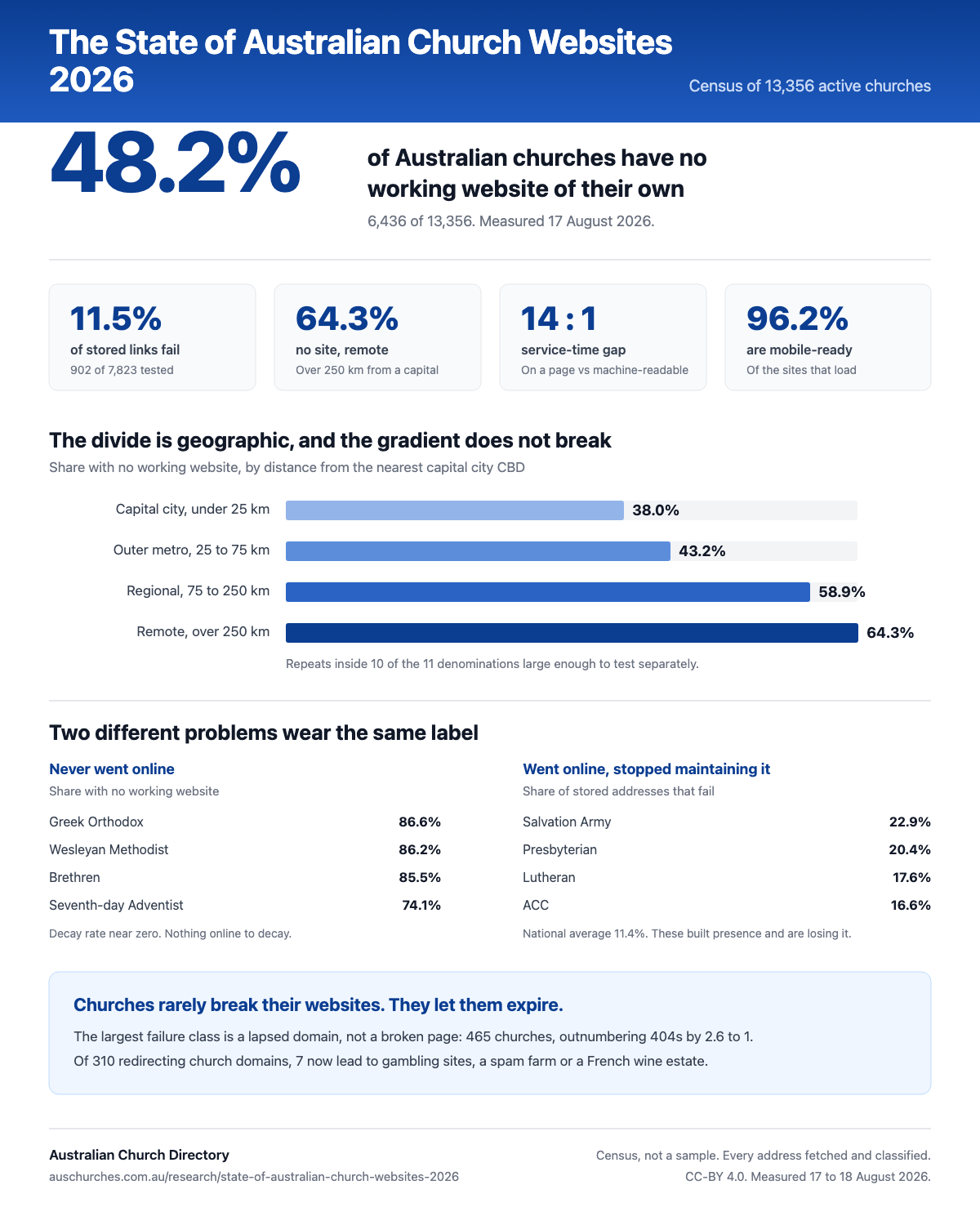
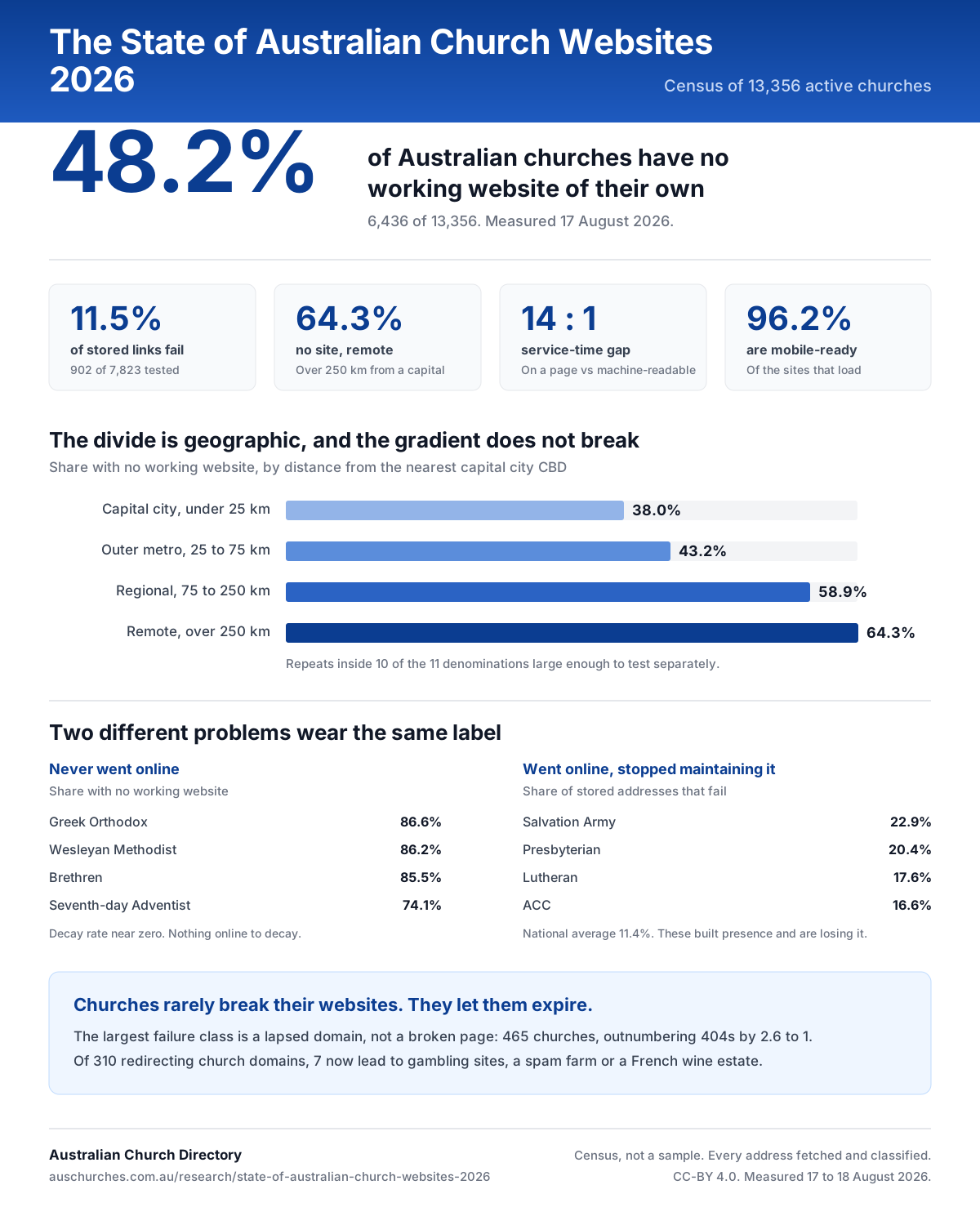
Nearly half of Australia's churches cannot be found on the web. On 17 August 2026, 6,436 of 13,356 active churches (48.2%) either held no website address at all, or held one that did not reach them. The gap widens with distance: 38.0% inside a capital city, 64.3% more than 250 km from one. The websites that do work are not the problem people assume, because 96.2% are mobile-ready. 4,998 churches publish a service time on their own homepage, and only 347 publish one that a machine can read.
2026 edition, version 1. Link audit measured 2026-08-17. Quality survey measured 2026-08-18. Aggregate tables under CC-BY 4.0. See the licence and reproduction notes at the foot of the page.
1. Nearly half of Australia's churches cannot be found on the web
This report combines two groups that are usually counted separately. 5,542 churches (41.5%) hold no website address at all. A further 894 hold an address that does not reach them. Together that is 6,436 churches, 48.2% of the sector.
The second group matters because nobody usually counts it. A directory, a denominational finder or a Business Profile records an address once and rarely tests it again. The address stays on the page and looks like presence.
The number a church directory reports is always better than the truth. Before this audit, the figure for Australian churches carrying a website was 58.6%. After testing every address, the figure for churches carrying a working website was 51.8%. The gap of 6.8 points is made entirely of links that had stopped working and that nobody had checked.
The web is the weakest channel a church keeps
An Australian church is more likely to have a phone number than a website. Telephone reach sits at 78.1%, a channel that predates the web by a century, and web presence sits 23 points behind it.
| Channel | Churches | Share |
|---|---|---|
| Phone number | 10,428 | 78.1% |
| Website address on file | 7,294 | 54.6% |
| Facebook page | 4,363 | 32.7% |
| Email address | 4,093 | 30.6% |
| Published service time | 347 | 2.6% |
The service-time figure is the one that should trouble a denomination. 97.4% of Australian churches do not publish, in any machine-readable place, the single fact a first-time visitor needs. A person searching “church near me” on a Saturday night finds a phone number for 4 churches out of 5. That person finds a service time for 1 in 40.
2. A link on file is not a website
Of the 7,823 churches that held a website address, 902 (11.5%) held one that did not reach them. A further 330 (4.2%) held one that reached a different site.
| Verdict | Churches | Share | Meaning |
|---|---|---|---|
| alive | 6,551 | 83.8% | Answers normally on its own domain |
| dns_gone | 465 | 6.0% | The hostname no longer resolves |
| redirect_offsite | 310 | 4.0% | Loads, but lands on a different domain |
| http_404 | 176 | 2.3% | The server answers, the page is gone |
| ssl_failure | 116 | 1.5% | Certificate or TLS handshake fails |
| http_4xx_other | 40 | 0.5% | Bot blocking. Treated as alive |
| connection_refused | 40 | 0.5% | Name resolves, nothing listens |
| bad_value | 28 | 0.4% | The stored value is not a usable address |
| http_5xx | 27 | 0.3% | Server errors on both passes |
| timeout | 26 | 0.3% | No response within 30 seconds |
| redirect_social | 20 | 0.3% | Lands on Facebook, YouTube or similar |
| parked | 12 | 0.2% | Registrar parking or suspended hosting |
| error_other | 3 | 0.0% | Unclassifiable, failed both passes |
| redirect_loop | 1 | 0.0% | Infinite redirect |
Churches rarely break their websites. They let them expire. dns_gone is the largest failure class by a wide margin, and it outnumbers 404 errors by 2.6 to 1. A 404 means somebody still pays for the domain and the server still answers. dns_gone means the registration lapsed and nobody renewed it.
That distinction decides what can be repaired. A 404 can often be recovered by walking up the path to the site root. A lapsed domain cannot be recovered at all, and it is available for anyone else to buy. Section 6 covers what happens next.
3. The denominational table
Every denomination with 80 or more active churches. “No URL” means no website address is held. “Dead” means one is held and it failed. “Decay” is the share of that denomination's stored addresses that fail, which is the number a denominational office can act on this quarter.
| Denomination | Churches | No URL | Dead | No working site | Decay |
|---|---|---|---|---|---|
| Catholic | 2,205 | 851 | 78 | 42.1% | 5.8% |
| Anglican | 2,035 | 831 | 173 | 49.3% | 14.4% |
| Uniting | 1,583 | 768 | 133 | 56.9% | 16.3% |
| Independent | 1,569 | 655 | 77 | 46.7% | 8.4% |
| Baptist | 1,208 | 496 | 57 | 45.8% | 8.0% |
| ACC | 785 | 298 | 81 | 48.3% | 16.6% |
| Seventh-day Adventist | 615 | 439 | 17 | 74.1% | 9.7% |
| Presbyterian | 557 | 174 | 78 | 45.2% | 20.4% |
| Lutheran | 536 | 58 | 84 | 26.5% | 17.6% |
| Pentecostal | 383 | 57 | 10 | 17.5% | 3.1% |
| Churches of Christ | 378 | 178 | 17 | 51.6% | 8.5% |
| Salvation Army | 301 | 100 | 46 | 48.5% | 22.9% |
| Greek Orthodox | 142 | 123 | 0 | 86.6% | 0.0% |
| Apostolic | 101 | 35 | 8 | 42.6% | 12.1% |
| Wesleyan Methodist | 94 | 80 | 1 | 86.2% | 7.1% |
| C3 | 91 | 5 | 11 | 17.6% | 12.8% |
| Evangelical | 84 | 17 | 4 | 25.0% | 6.0% |
| Brethren | 83 | 71 | 0 | 85.5% | 0.0% |
| Reformed | 82 | 10 | 2 | 14.6% | 2.8% |
| All churches | 13,356 | 5,542 | 894 | 48.2% | 11.4% |
Two different problems wear the same label
Some denominations have never been online. Greek Orthodox (86.6%), Wesleyan Methodist (86.2%), Brethren (85.5%) and Seventh-day Adventist (74.1%) sit at the top of the table. They sit there almost entirely because their congregations hold no website address at all. Greek Orthodox and Brethren record a decay rate of 0.0%, because they have almost nothing online to decay. For these bodies the work is a first website, not a repair.
Other denominations went online and then stopped maintaining it. The Salvation Army has 22.9% of its stored addresses failing, the highest decay rate of any body measured. Presbyterian follows at 20.4%, Lutheran at 17.6%, ACC at 16.6% and Uniting at 16.3%. These bodies built web presence and are now losing it.
Lutheran is the clearest case of the second pattern. Only 58 of 536 Lutheran churches (10.8%) hold no address, the best coverage of any large denomination. But 84 of the 478 that do hold one are broken, so Lutheran ranks 3rd worst on decay. 25 of those losses came from a single domain, lutheran.org.au, which hosted congregations on subdomains.
Pentecostal, C3 and Reformed lead the table. All 3 sit under 18%. Their churches are newer, more centrally administered, or both.
4. The divide is geographic, and it is steep
Distance from the nearest capital city central business district predicts web presence across the whole sector. 12,699 churches carry coordinates and appear in this table.
| Distance from a capital CBD | Churches | No URL | Dead | No working site | Decay |
|---|---|---|---|---|---|
| Capital city, under 25 km | 5,185 | 1,647 | 321 | 38.0% | 9.1% |
| Outer metro, 25 to 75 km | 2,797 | 1,013 | 195 | 43.2% | 10.9% |
| Regional, 75 to 250 km | 3,087 | 1,583 | 235 | 58.9% | 15.6% |
| Remote, over 250 km | 1,638 | 953 | 101 | 64.3% | 14.7% |
The gradient does not break. Each band is worse than the one closer in.
Distance predicts decay as well as absence. The share of stored addresses that fail rises from 9.1% inside a capital city to 15.6% in the regional band. A regional church is not only less likely to have a website. The website it has is 71% more likely to be broken.
This is where search demand is least well served.Australian search for churches runs at roughly 329,000 queries per month, and 58.3% of that is “near me” discovery. A person searching in a regional town faces close to a 3 in 5 chance of a nearest church that gives the search engine nothing.
The gradient repeats inside almost every denomination
Distance and denomination are not the same effect wearing 2 labels. The share of churches with no working website, split both ways. Every cell rests on at least 25 churches.
| Denomination | Capital | Outer metro | Regional | Remote |
|---|---|---|---|---|
| Catholic | 21% | 24% | 61% | 71% |
| Anglican | 30% | 38% | 60% | 70% |
| Uniting | 41% | 58% | 69% | 65% |
| Independent | 40% | 50% | 53% | 75% |
| Baptist | 43% | 42% | 56% | 50% |
| ACC | 50% | 47% | 39% | 59% |
| Presbyterian | 35% | 29% | 58% | 69% |
| Lutheran | 28% | 23% | 29% | 24% |
| Churches of Christ | 52% | 54% | 47% | 56% |
| Salvation Army | 40% | 42% | 54% | 62% |
| Seventh-day Adventist | 62% | 72% | 91% | 75% |
A remote church is worse off than a capital-city church of its own denomination in 10 of these 11 bodies. The effect is largest in the 2 largest denominations. A remote Catholic parish is 3.4 times more likely than a Sydney or Melbourne one to have no working website. For Anglicans the ratio is 2.3.
Lutheran is the single exception, and it is instructive. Lutheran churches run between 23% and 29% across all 4 bands, with no gradient at all. Lutheran also has the best raw coverage of any large denomination. Whatever produces that result travels to the bush, which none of the other 10 bodies manage.
By state and territory
| State | Churches | No URL | Dead | No working site | Decay |
|---|---|---|---|---|---|
| New South Wales | 4,131 | 1,729 | 336 | 50.0% | 14.0% |
| Victoria | 2,978 | 1,289 | 224 | 50.8% | 13.3% |
| Queensland | 2,735 | 1,058 | 136 | 43.7% | 8.1% |
| South Australia | 1,396 | 534 | 87 | 44.5% | 10.1% |
| Western Australia | 1,387 | 590 | 49 | 46.1% | 6.1% |
| Tasmania | 398 | 211 | 42 | 63.6% | 22.5% |
| ACT | 174 | 45 | 8 | 30.5% | 6.2% |
| Northern Territory | 165 | 93 | 12 | 63.6% | 16.7% |
Tasmania and the Northern Territory share the worst result at 63.6%, for opposite reasons.Tasmania has the highest decay rate in the country at 22.5%, more than 3 times Western Australia's. The Northern Territory has the second lowest share of churches holding any address. Tasmania is losing what it had. The Northern Territory never had it.
5. The sites that do work are in better shape than expected
A second survey on 2026-08-18 re-fetched every address the directory held after the repairs in section 8: 6,394 addresses covering 7,295 churches. 6,102 addresses, covering 6,970 churches, answered normally. This section describes those 6,970.
| Measure, among the 6,970 churches whose site loads | Churches | Share |
|---|---|---|
| Mobile viewport declared | 6,705 | 96.2% |
| Supports HTTPS | 6,832 | 98.0% |
| A service time appears on the homepage | 4,998 | 71.7% |
| Structured data (JSON-LD) present | 3,313 | 47.5% |
| States a copyright year | 3,534 | 50.7% |
Mobile and HTTPS are solved problems. 96.2% of working church sites declare a mobile viewport, and 98.0% support HTTPS. The common assumption that church websites are stuck in the desktop era is wrong. Any church site built or rebuilt in the last decade got both by default from its platform.
The remaining problem is machine-readability. A person can read these sites. Almost nothing else can.
The service times exist. They are just not readable by a machine
4,998 churches publish a service time on their own homepage. 347 churches have a service time recorded in any machine-readable form. The ratio is 14 to 1.
This is the single largest gap the report found. For 71.7% of churches with a working site, the church has already written the time down on its own front page. It sits there as prose inside a page layout. No search engine result, no map listing, no directory and no AI assistant can extract it reliably.
52.5% of working church sites carry no structured data at all. Without JSON-LD, a service time on a page is a sentence, not a fact. Search engines and answer engines both have to guess, and they mostly decline to guess.
The combination is what produces the 2.6% figure in section 1. The sector does not have a content problem. It has a markup problem.
A fifth of church websites have not been touched since 2023
3,534 working church sites state a copyright year. That year is the cheapest available proxy for when somebody last edited the site.
| Year stated | Churches | Share of those stating a year |
|---|---|---|
| 2026 | 2,184 | 61.8% |
| 2025 | 269 | 7.6% |
| 2024 | 387 | 11.0% |
| 2023 | 137 | 3.9% |
| 2022 | 144 | 4.1% |
| 2021 | 70 | 2.0% |
| 2020 or earlier | 343 | 9.7% |
38.2% state a year earlier than 2026. 19.6% state 2023 or earlier. 9.7% state 2020 or earlier. 22 sites still state a year in the 2000s. The oldest states 2000.
A stale year is not proof of a stale site, and a current year is not proof of a maintained one. Many platforms print the current year automatically, which inflates the 2026 figure. The number to read is the tail: 343 churches run a site whose own footer has not changed in 6 years or more.
What this survey cannot measure
- It reads the HTML a server sends. It does not run JavaScript.A site that renders in the browser looks empty to this method. 448 of the 6,970 churches (6.4%) returned fewer than 500 characters of visible text, which is the signature of that pattern. 392 of those sit in the “no service time” group, so the 71.7% figure is a floor, not a ceiling.
- It reads the homepage only.A church that publishes its times on a separate page counts as “no service time on the homepage” here. That is the intended measure, because a person arriving from a search result lands on the homepage. It is not the same as “the church does not publish its times”.
- A service time appearing is a signal, not an extraction. The method looks for a clock time within 150 characters of a service or weekday word. It does not confirm that the time is correct or current.
6. An expired church domain becomes somebody else's asset
This is the finding with the shortest path to harm, and no directory or denominational finder currently checks for it.
310 church addresses redirected to a different domain. Most were ordinary: a parish moved to a new domain, or folded into a diocese site. 6 domains, carrying 7 churches, did not.
| Congregation | Domain it had | Where the domain now leads |
|---|---|---|
| 2 Lutheran congregations, SA | robertstown.info | Spam mirror that copies the church name into its own URL path |
| Catholic parish, VIC | elwoodstkildawestparish.org | CM88 gambling |
| Independent church, WA | mosaicwa.com | Judi Bola gambling |
| Catholic parish, VIC | fatimarosebud.org | A French wine estate |
| Presbyterian church, QLD | spchurch.com.au | Deactivated-domain placeholder |
| Uniting church, NSW | crowsnestuniting.org.au | QR shortener to a social page |
The congregations are not named here, deliberately.Every one of them is the party harmed. A volunteer missed a domain renewal, which is an administrative slip and not a failing worth attaching a congregation's name to permanently. The domains are given because they are facts about domains rather than about people, and because they let anybody verify the finding independently. All 6 destinations were re-verified on 2026-08-18 and are unchanged.
2.3% of redirecting church domains had been taken over by content a church directory must never link to.The rate is small. The consequence is not. Every one of these addresses was still recorded as the church's own website, on a page that carried the church's name.
The spam imitates the church, and defeats the obvious check
The operators who buy expired church domains keep the church identity in the address. One served the path /en/generic/geranium-plain-lutheran-church/. Any automated check that reads the destination address sees “lutheran-church” and passes it. The page title said “Generick Fitness Online Coaching”.
The rule this produces: match the destination host and read the page title. Never trust the path.
A domain named after a church proves nothing about the page
The same error appears without any bad actor involved. An earlier repair pass “recovered” 8 domains that answer normally and contain nothing: registrar parking, hosting error pages, a bare web server default, a “Site Not Found” page, and a consent-management shell. All 8 passed a keyword check. The check accepted a church word anywhere, including in the hostname, and every one of those domains is named after a church.
A denomination in a name is not evidence of a church either.One South Australian Lutheran parish recorded a domain that now leads to an aged-care provider run by the same denomination. Every automated check passes on the word “lutheran”.
Reverting is not a repair. When a stored address redirects to gambling content, restoring the previously stored value changes nothing, because the stored address is the thing that redirects. The only safe outcome is to remove it.
7. Churches on a shared domain fail together
31.2% of the dead links, 160 of 513, sat on a registrable domain shared with at least one other church. When that domain lapsed, every congregation on it disappeared at once.
| Domain | Congregations lost |
|---|---|
| lutheran.org.au | 25 |
| anglican.asn.au | 11 |
| unitingchurch.org.au | 7 |
| merseylevencatholicparish.com | 6 |
| mdpresbytery.org.au | 4 |
| anglicansouthernmonaro.org.au | 4 |
| anglicanwaggawagga.com.au | 4 |
| juneeanglican.org.au | 4 |
Shared hosting concentrates risk that no individual church can see.A parish given a subdomain on the national body's platform has no registration to renew and no invoice to miss. It also has no control. The national body can retire the platform or let the domain lapse. The parish then loses its web address, with no action and no warning on its part.
3 of the 12 parked domains sat behind one suspended hosting account. A single unpaid invoice removed 3 churches from the web.
8. What is repairable, and how cheaply
Not every broken link is a lost church. 381 of the 902 failures were repaired without contacting anybody.
40 churches needed a www prefix toggled. Of 116 certificate failures, 57 were repaired. 40 of those needed only the prefix changed, because the certificate had been issued for one hostname and the directory recorded the other. The site had been working the whole time, for anyone who typed the address the other way. 17 more answered on plain http.
29 of 176 dead pages were recovered by walking up the path. A 404 means the server answers and only the recorded page is gone, so the repair walks from the recorded page to each parent and then to the root.
Walking up a path is a guess, and the guess degrades the higher it goes. A redirect is the site owner stating where the content moved. Walking up is an inference. Without a guard, the method “recovered” 101 rows. Those included 41 Salvation Army corps all pointing at the national homepage and 5 Townsville parishes at their diocese. 8 unrelated entities landed on a single parish page, and 2 of those were nursing homes.
The guard that makes it safe: a page claimed by 3 or more distinct church names is the parent body, not any one church.10 more needed a person. Each answers normally and passes every automated check while being the wrong link: a synod news article, a local council, a parish school, national and state denominational bodies, an archdiocese, a presbytery, and 3 other directories' index pages. A list of churches is not a church.
295 addresses were moved forward to where they now lead. A redirect is a countdown, not a resting state. It works only while somebody keeps paying for the old domain. The moment that registration lapses, the redirect stops and the address joins the dns_gone class. That is exactly how the 511 removed addresses died.
9. What this means, and for whom
For a denominational office
- Your decay rate is the number you can act on this quarter. The share of your congregations with no website at all is a long programme. The share holding a broken one is a list, and most of that list costs minutes per church.
- Start with the certificate failures and the malformed values. Between them they account for 40 repairs that needed a prefix toggled and 31 that needed a text string deleted.
- Then mark up the service times you already publish. 71.7% of your working parish sites already state a time on the homepage. Adding JSON-LD costs a template change, once, across every parish on a shared platform.
- Audit any domain you host congregations on. 31.2% of the losses in this report came from shared domains. A parish on your subdomain cannot renew a registration it does not hold.
- Check what your lapsed domains now serve.A church domain you allow to expire does not go quiet, and your congregation's name stays attached to whatever arrives.
For a church
- Test your own address the way a stranger would. Type it with and without
www, and with https. 40 churches in this report had a working site that failed only because the recorded address used the wrong form. - Mark up the service time you already publish. 7 in 10 working church sites state a time on the homepage, and fewer than half carry any structured data. Ask whoever maintains the site for ChurchService or Event JSON-LD. It is a one-off change.
- Your site is probably fine on mobile. Spend the effort on the address and the markup instead.
- Hold your own domain registration if you can. A subdomain from a parent body costs nothing and can be withdrawn without warning.
For anyone publishing a church directory
- A recorded address is not evidence of a website. Test what you hold, on a schedule, and treat the result as data rather than a one-time clean-up.
- Read the page, never the address. Section 6 gives 2 different failures that a URL-based check cannot catch and a title-based check catches immediately.
- Never condemn a site on a single failed fetch. 45 of 680 first-pass failures in this report were alive on a second attempt.
- Removing a bad address is a repair. A directory page that links a church to a gambling site is worse than one that links nowhere.
10. Method
What was measured. The Australian Church Directory held 13,356 active, in-scope churches on 2026-08-18, excluding 6 honeypot rows planted to detect scraping and 2 rows marked out of scope. Of those, 7,823 held a website address on 2026-08-17. Every one of the 6,901 distinct addresses behind them was fetched over HTTP and classified into 1 of 14 verdicts.
How a dead verdict was established. A single failed fetch does not prove a site is dead. Every network failure retried up to 3 times with backoff inside each pass. Every non-alive verdict was re-probed in a second pass that started after the whole sweep finished, giving up to 30 minutes of separation, and the second verdict won. A dns_gone verdict also required the operating system resolver to agree.
The second pass changed 45 verdicts. 680 addresses failed the first pass and 45 of them answered on the second, 33 of those having been classified dns_gone. Without the second pass this report would have reported 947 failures instead of 902, an overstatement of 5.0%. A third probe, run at write time, spared 4 more sites that had come back to life, and hand-checking every flapping verdict restored 2 that had been wrongly condemned.
The sweeps ran on Python 3.12 with OpenSSL 3.6. The macOS system Python links LibreSSL 2.8.3, which fails modern TLS handshakes and reports live sites as certificate failures.
Limits you should read before quoting this report
- This is a census of one directory, not of Australia. No official register of Australian churches exists, so no external total can confirm coverage. A church with no website is harder to find and harder to list, so the true national rate is more likely understated than overstated.
- Denominational labels come from the directory's own classification. “Independent” carries 1,569 churches and is a residual category, not a denomination.
- 4 addresses were excluded from condemnation as a local artifact. The router on the measuring network filters some domains by DNS and answers with its own block page. Those 4 are unverifiable from that network, not dead.
- 657 rows lack coordinates and are excluded from the distance analysis in section 4 only. They appear in every other table.
Frequently asked questions
- How many Australian churches have a website?
- On 17 August 2026, 7,823 of 13,356 active Australian churches held a website address, but 902 of those addresses did not reach the church. Combining the two, 6,436 churches (48.2%) had no working website of their own. Counting only the addresses on file, and never testing them, produces a much rosier 58.6%.
- What proportion of Australian church websites are broken?
- 11.5%. Of the 7,823 website addresses held for Australian churches, 902 failed to reach the church across two temporally separated fetch passes. A further 330 (4.2%) loaded but landed on a different site than the one recorded.
- How do church websites usually die?
- They expire rather than break. The largest single failure class is dns_gone, meaning the domain registration lapsed and the hostname no longer resolves: 465 churches, 6.0% of every church holding an address. Lapsed domains outnumber broken pages by 2.6 to 1. A broken page can often be repaired by walking up to the site root. A lapsed domain cannot be recovered at all, and anyone else can buy it.
- Which Australian denomination has the worst church website coverage?
- Greek Orthodox at 86.6% with no working website, then Wesleyan Methodist at 86.2% and Brethren at 85.5%. Those three sit at the top because their congregations hold no website address at all, not because their sites break. Measured on decay instead, the Salvation Army leads at 22.9% of stored addresses failing, then Presbyterian at 20.4% and Lutheran at 17.6%.
- Are regional Australian churches less likely to have a website?
- Substantially. The share with no working website rises from 38.0% inside a capital city to 43.2% in outer metro, 58.9% in regional areas and 64.3% more than 250 km from a capital. The gradient is unbroken and it repeats inside 10 of the 11 denominations large enough to test separately. A remote Catholic parish is 3.4 times more likely than a Sydney or Melbourne one to have no working website.
- Do Australian church websites work on mobile phones?
- Almost all of them do. Of the 6,970 churches whose website loads, 96.2% declare a mobile viewport and 98.0% support HTTPS. The common assumption that church websites are stuck in the desktop era is wrong. The real gap is machine readability, not presentation.
- Why can I not find church service times online?
- The times are usually published, but not in a form software can read. 4,998 churches state a service time on their own homepage, while only 347 have one recorded in any machine-readable form, a ratio of 14 to 1. 52.5% of working church sites carry no structured data at all, so a service time on the page is a sentence rather than a fact a search engine or AI assistant can extract.
- What happens to a church domain name after it expires?
- Somebody else can register it, and the content that follows often keeps the church name. Of 310 church addresses that redirected elsewhere, 7 landed on gambling sites, a fitness spam farm, a French wine estate or a placeholder. One gambling site served the path /en/generic/geranium-plain-lutheran-church/, which passes any automated check that reads the destination address instead of the destination page.
- How was this research conducted?
- Every website address held for the 13,356 active churches in the Australian Church Directory was fetched over HTTP and classified into one of 14 verdicts. Every network failure retried up to 3 times, and every non-alive verdict was re-probed in a second pass after the whole sweep finished, with the second verdict winning. That second pass rescued 45 sites that had failed the first. A follow-up survey on 18 August 2026 re-fetched every address to measure mobile viewport, HTTPS support, service times on the homepage, structured data and the stated copyright year.
Related
- Church density in Australia: Q3 2026 – how Christianity maps to geography, benchmarked against ABS Census data.
- For researchers – coverage statistics, methodology, citation guidance and data access.
- All denominations – full index of denominations covered in the directory.
Data availability, licence and reproduction
Every aggregate table on this page is published under a Creative Commons Attribution 4.0 International (CC-BY 4.0) licence. You may reproduce, quote, republish or build on them provided you attribute: “Australian Church Directory (auschurches.com.au), The State of Australian Church Websites 2026.” Individual church-level listing data remains copyright Australian Church Directory. For press, licensing or data enquiries: hello@auschurches.com.au.
How to cite: AusChurches (2026). The State of Australian Church Websites 2026. auschurches.com.au, 18 August 2026.
Reproduction. Per-address verdicts, per-URL evidence and the aggregate figures behind every table are held as published data files alongside the classification sweep, the quality survey and the analysis script that regenerates each figure. Request access at the address above.
Repackaged formats, all CC-BY 4.0. Attribute “Australian Church Directory, The State of Australian Church Websites 2026”:
- 1-page summary (PDF) – single A4 page: the headline, the 4 key figures, the distance gradient and the denominational split. For press pitches and briefing packs.
- Infographic (PNG) – 1200×1500 px portrait. Sized for LinkedIn and X feed cards.
- Infographic (SVG) – vector source, for print or higher-resolution reuse.
- Slide deck (HTML) – 12 slides covering the headline, the gradient, the denominational split, the expired-domain hazard and the method. Keyboard-navigable, and prints to PDF.
Next edition: this report will be re-measured and re-published. This version keeps its own stamped URL so a citation of the 2026 figures stays resolvable after the next measurement replaces them.